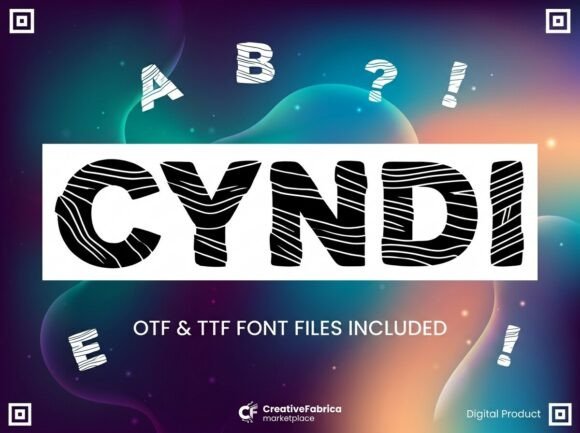
Cyndi Display Font for Handmade Creators
As a maker who designs printable invitations, hand-stamped tags, and SVG cut files for mugs and tote bags, I’ve learned that the right display font doesn’t just look pretty—it builds trust, signals quality, and makes customers pause mid-scroll. That’s why Cyndi has quickly become my go-to decorative typeface for projects where personality and polish matter equally.
Cyndi is a bold, expressive display font with strong artistic DNA—think confident curves, intentional contrast, and subtle flourishes that feel handmade, not overdesigned. It’s not a script or a serif, but something more distinctive: a contemporary display font built to command attention without sacrificing legibility. Its visual personality leans warm and approachable, yet refined enough for boutique packaging or wedding stationery. When I use Cyndi on a candle label or welcome sign, customers consistently comment on how “thoughtful” and “intentional” the design feels—even before they read a word.
Where Cyndi Shines in Real Craft Projects
This isn’t a font for body text or fine print. Cyndi thrives where you need impact: short phrases, names, titles, and decorative wording. I use it most often for:
- Product labels—especially for small-batch goods like bath salts, honey jars, or artisan soap. Its clean letterforms hold up beautifully at 14–20 pt when printed on kraft tags or matte sticker paper.
- Stickers and decals—Cyndi cuts cleanly on Cricut and Silhouette machines. I’ve tested it down to 0.75" tall with no loss of character integrity, making it ideal for mini gift tags or planner stickers.
- Invitations & wedding stationery—the “Mr. & Mrs.” line on a rustic welcome board, monogrammed napkin prints, or foil-stamped save-the-dates. Its rhythm guides the eye naturally, never competing with delicate florals or textured backgrounds.
- Digital printables—planner covers, quote pages, and wall art PDFs. Because Cyndi renders crisply at high resolution, it looks premium in both print and digital mockups—no pixelation, no awkward spacing.
- Seasonal and holiday designs—think “Gather,” “Joy,” or “Cozy” on farmhouse signs, mug wraps, or Christmas ornament tags. Its warmth reads as sincere, not cliché.
Readability + Production Reality
Let’s be practical: a beautiful font is useless if your cutting machine skips a curve or your printer blurs the details. Cyndi was clearly designed with physical production in mind. The counters (the enclosed spaces inside letters like ‘e’ or ‘a’) are open and generous. Stroke endings are clean—not overly tapered—so they don’t vanish at small sizes. And because it’s a single-weight display font (not a full family), there’s no confusion about which style to use for your project. What you see is what cuts, prints, and sells.
That said, I always test Cyndi at actual output size before finalizing a design. For example: on 1.25" round stickers, I keep text to three words max. On product tags under 2", I avoid using swashes or alternate characters unless they’re essential to the brand voice—I reserve those for larger applications like wall art or social media banners.
Smart Pairings for Balanced Design
Cyndi works best when paired intentionally—not just “pretty with pretty.” Its expressive nature means it needs grounding. Here’s what I reach for:
- A clean, neutral sans serif (like Montserrat or Inter) for supporting text—ingredients lists, dates, or fine print on invitations.
- A gentle handwritten font (with modest slant and consistent baseline) for personal notes or quotes alongside Cyndi headlines.
- A quiet serif (such as Lora or Merriweather) for elegant contrast—great for bridal shower invites or boutique packaging where tradition meets modernity.
The key is contrast without competition. Cyndi leads; the secondary font supports. Never pair it with another bold display font—that’s visual noise, not harmony.
Licensing, Files, and What You’ll Actually Get
Cyndi comes as a standard OTF file—fully compatible with Canva, Adobe Suite, Cricut Design Space, Silhouette Studio, and Affinity apps. No web fonts or variable weights, which keeps things simple for crafters who need reliability over complexity. There are no language limitations listed, but I’ve successfully used it for English, Spanish, and French phrases in my shop listings without missing glyphs.
Crucially, Cyndi includes commercial licensing—meaning you can use it in products you sell: physical items (mugs, shirts, tags), digital downloads (printables, templates, SVG bundles), and client work (like custom invitation suites). Just remember: you’re licensing usage rights, not resale rights to the font file itself. That’s standard—and smart—for any premium font used in a small business.
Why This Font Fits Your Shop Identity
When customers choose handmade, they’re choosing intention. Cyndi reflects that. It doesn’t shout. It stands with quiet confidence—like a well-glazed ceramic mug or a hand-stitched linen tag. Using it consistently across your labels, social graphics, and packaging strengthens brand recognition. Over time, your audience begins to associate that distinct letterform rhythm with your shop’s aesthetic and values.
I’ve seen it happen: a customer tags me in an Instagram story showing their Cyndi-labeled lavender sachets beside my matching printable gift tag. That’s not coincidence—it’s cohesion. And cohesion sells.
If you're selecting a display font for your next batch of physical or digital products, ask yourself: does it elevate the product—or distract from it? Does it feel like *you*, even when scaled down or printed on textured paper? With Cyndi, the answer is yes—every time.